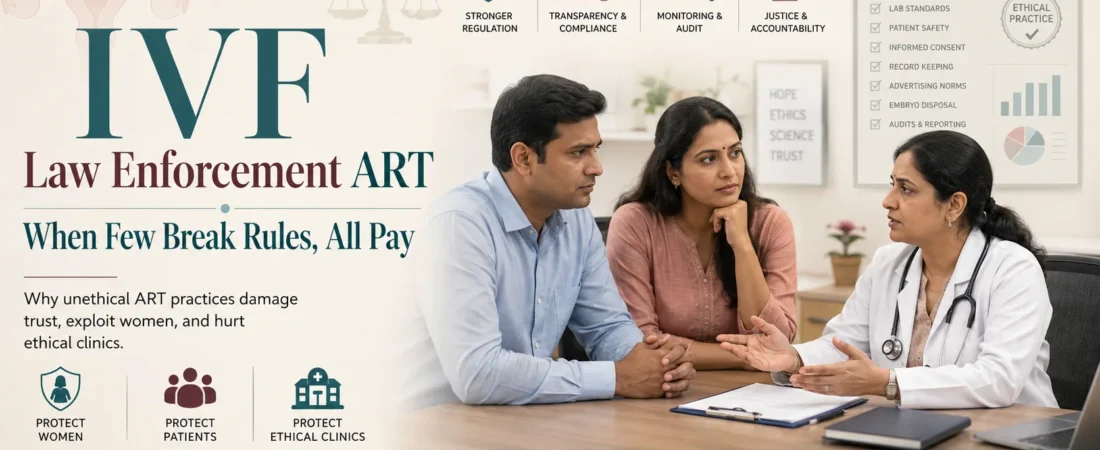
IVF law enforcement failures in ART practices hurt everyone — from vulnerable women to ethical clinics working tirelessly to do the right thing. Every time a case of unethical egg extraction or illegal ART activity surfaces, it does more than expose a crime. It chips away at the trust that thousands of ethical IVF professionals work tirelessly to build. It shakes the confidence of patients who are already emotionally and financially vulnerable. Furthermore, it tarnishes a field whose very purpose is to create life with dignity, consent, and compassion.
Recently, yet another incident has come to light — one that mirrors the concerns I raised in my earlier post. Once again, it forces us to confront a difficult truth: the problem is no longer isolated. It is systemic, growing, and emboldened by weak enforcement.
IVF Law Enforcement Failure: The Real Issue Behind Unethical ART Practices
India does have strong legislation in place. The government created the ART (Regulation) Act and the Surrogacy Act to protect women, donors, and intended parents. They clearly define who can donate, how often, under what conditions, and with what safeguards. However, laws are only as strong as their implementation.
When clinics or agents bypass consent, forge documents, or repeatedly exploit vulnerable women, it is not a loophole — it is a failure of oversight. Every such failure harms:
- Women who are coerced or misled
- Families who unknowingly participate in illegal cycles
- Ethical clinics who follow the law yet lose credibility because others don’t
- The reputation of the entire reproductive medicine ecosystem
This is not just malpractice. It is exploitation. And it must be treated as such.
Why Unethical IVF Practices Are Dangerous for Everyone
If such practices continue unchecked, the consequences will be far-reaching:
- Women’s health will be compromised
- Trust in IVF will erode
- International perception of India’s ART ecosystem will suffer
- Genuine patients may hesitate to seek help
- Ethical clinics will be overshadowed by sensational headlines
The damage is deeply unfair to the many professionals who uphold the highest standards every single day.
What Needs to Change Now in IVF and ART Regulation
To protect women and restore faith in the system, we need stronger, more visible action:
- Routine audits of IVF and ART centres
- Strict digital tracking of donor histories to prevent repeated exploitation
- Authorities must immediately suspend centres found violating the law
- Courts must hold agents, middlemen, and colluding medical staff criminally accountable
- Anonymous reporting channels for whistleblowers within clinics
- Public transparency about actions taken, so trust can be rebuilt
Regulation is not the enemy of progress. Indeed, it is the foundation of ethical progress.
The Questions the IVF Community Must Answer
As a community, we must ask ourselves some important questions:
- How do we ensure that vulnerable women are never treated as commodities?
- What systems can we build to make violations impossible — not just punishable?
- How can ethical clinics reclaim the narrative and protect the integrity of IVF?
- How do we restore trust for the families who come to us with hope?
This conversation is overdue. Therefore, it’s time we address it with the seriousness it deserves.