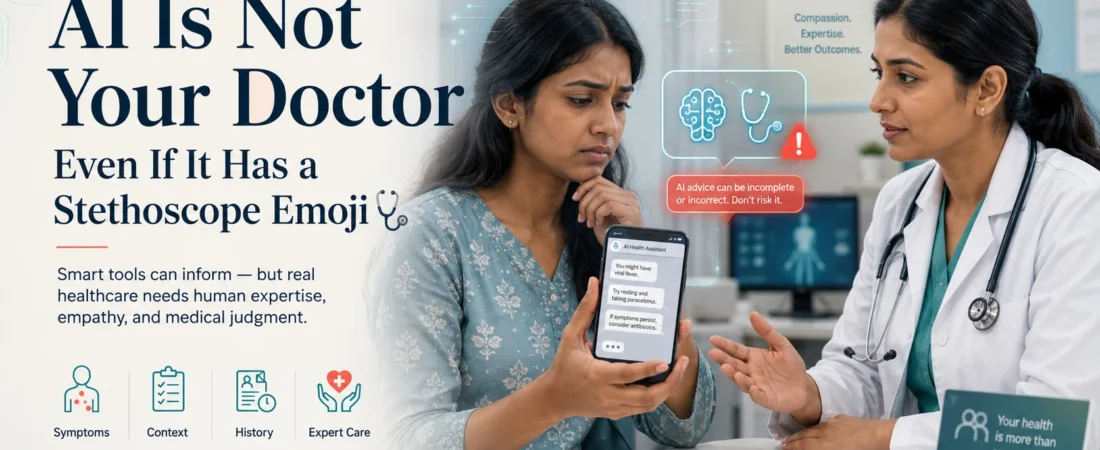
AI is not your doctor – no matter how smart or fast its answers may seem. As a life coach and IVF consultant, I meet people every day who are navigating deeply personal and often complex health journeys. Recently, I’ve noticed a concerning trend: an increasing number of individuals are turning to AI chatbots for medical advice. Not for general information, mind you—but for actual diagnosis and treatment suggestions. And it’s not just a quirky habit. It’s becoming a dangerous shortcut.
Recent articles have highlighted cases where AI recommended swapping sodium chloride (table salt) with sodium bromide—a compound that can be toxic. That’s not just a typo. That’s a potential obituary.
Let’s be clear: AI is brilliant at many things. It can write poems, plan your vacation, and even help you draft a polite email to your boss. But diagnosing your chest pain or advising on your child’s fever? That’s where the line must be drawn—with a thick, neon marker.
Why AI Is Not Your Doctor When It Comes to Your Health
Doctors don’t just prescribe based on symptoms. They read between the lines, ask the right questions, and consider your medical history, lifestyle, and emotional state. AI, on the other hand, doesn’t know if you’re allergic to penicillin or just panicking because WebMD told you your headache is a brain tumour.
And here’s the kicker: when patients walk into clinics armed with AI-generated “diagnoses,” it doesn’t just confuse the treatment process—it undermines the expertise of real doctors. Imagine trying to perform surgery while your patient insists that ChatGPT said turmeric would do the trick.
We’re not saying AI has no place in healthcare. It can assist with research, streamline documentation, and even support mental health in limited ways. But it’s not a replacement for trained professionals who’ve spent years mastering the art and science of healing.
AI operates on prompts—what you ask is what you get. And sometimes, what you get depends entirely on how you ask. A slight change in phrasing can lead to wildly different answers, some helpful, others hilariously off-track or dangerously misleading. It doesn’t “know” your body, your history, or your context—it just predicts text. So unless your symptoms come with a perfectly worded prompt and a disclaimer, you’re better off trusting someone who doesn’t need autocomplete to save your life.
So, if you’re feeling unwell, please – step away from the chatbot and step into a clinic. Your health deserves more than a predictive algorithm. It deserves human care, empathy, and expertise.
Let’s use AI wisely, not as a doctor, but as a helpful assistant who knows its limits.